Best Hairstyles for Square Faces: Soften Strong Jawlines
Want to see hairstyles on your face?
Start with your face-shape result, then explore hairstyle directions for length, layers, bangs, and volume.
Find your face shape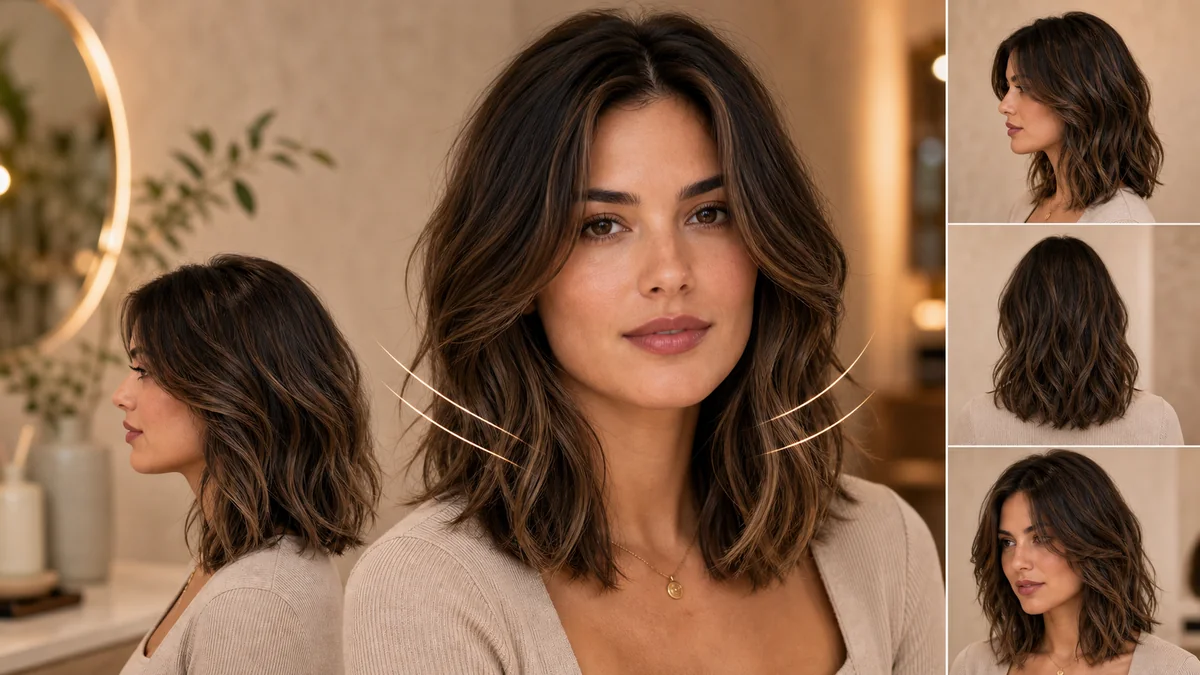
Quick Answer
Square faces have a defined jawline with similar width across the forehead, cheekbones, and jaw. The most helpful styling directions add softness through layers, texture, and movement while preserving the face's natural strength. Medium-to-long styles with soft layers, waves, and off-center parting are common starting points. The goal is to soften, not to hide the jawline. If you prefer shorter hair, texture and rounded silhouettes become more important. If you prefer straight hair, you will need more intervention from layers and parting to break up the lines.
Understanding Square Face Proportions
A square face has similar width across the forehead, cheekbones, and jaw, creating a strong horizontal structure. The jawline is defined with visible corners, and the face length and width are relatively close. This gives the face a bold, angular appearance that reads as strong and distinctive. The straight lines of the forehead and jaw create a geometric quality that can look severe without the right hair texture and movement to balance it.
The Styling Goal
The primary goal for square faces is to soften the strong angles of the jawline while keeping the face's natural structure. You want to add movement and texture that interrupt the straight lines without making the overall look shapeless. The jawline is a defining feature, not a flaw, so the aim is balance rather than concealment. Curves, layers, and asymmetry all help introduce softness where the face has angles.
How Length, Layers, and Volume Work Together
Length that passes the jaw creates a softer silhouette because the hair extends beyond the face's hardest angle. Layers add movement that breaks up straight lines, creating visual interest that distracts from geometric precision. Texture, whether from waves or curls, introduces curves where the face has angles. Volume at the sides can soften the jaw corner by creating a rounded transition between the face and the neck. Parting affects how the hair frames the face: a strict center part mirrors the face's symmetry, while an off-center or side part introduces asymmetry that softens the overall impression. The interaction matters: length without texture can hang heavily, while texture without length can bounce in ways that draw attention to the jaw.
Hairstyle Directions to Explore
- Medium-to-long with soft layers: Layers that start below the chin and continue downward create movement that breaks up the face's straight lines. The length passes the jaw, softening the transition from face to neck.
- Waves or curls that move past the jaw: Waves introduce curves that contrast with the face's angles. When the hair moves past the jaw corner, it creates a softer outer silhouette.
- Collarbone-length with texture: A lob or textured cut at collarbone length sits below the jaw and can be styled with waves or piece-y texture that adds softness without requiring long hair.
- Off-center or side part: Parting away from the center breaks the face's symmetry and introduces a diagonal line that softens the overall structure.
How Layers, Texture, and Parting Work Together to Soften a Strong Jawline
Hair that stops directly at the jaw corner emphasizes the angle. This is the jaw-corner principle: when hair ends exactly where the jaw turns, the eye is drawn to that point and the angularity is highlighted. Passing two to three centimeters above or below the jaw corner changes the silhouette because the hair no longer frames the angle precisely. Above the jaw, a shorter cut creates its own rounded outline. Below the jaw, longer hair extends past the angle and creates a softer edge.
Layers, texture, and parting are three independent levers that each soften the jaw in different ways. Layers create internal movement and break up the outer line. Texture introduces curves and irregularity. Parting changes how the hair falls across the face and whether the framing is symmetrical or not. Combining all three can over-soften and look shapeless, so most people benefit from emphasizing one or two while keeping the third moderate.
Straight hair needs the most curl or wave intervention because it follows the face's lines most precisely. Naturally wavy hair is already partly solved because the texture introduces curves without styling effort. A blunt cut ending at the jaw is the most challenging direction because it frames the face's hardest angle with a hard line.
Maintenance cycles matter more for square faces than for some other shapes. At four weeks, the cut retains its intended shape and the layers or texture still function as designed. At eight weeks, the shape decays and the ends may start to flip or widen in ways that can actually soften the look further, but with less control. If you prefer a maintained, intentional softness, schedule cuts every four weeks. If you prefer a more relaxed, lived-in softness, you can stretch to six or eight weeks.
For Women: What to Prioritize
- Long hair with soft layers that pass the jaw, creating a softer outer silhouette
- Medium length with waves or curls that introduce curves and movement
- Collarbone lob with texture, keeping the length below the jaw corner
- Off-center or side part, not a strict center part, to break symmetry
- Avoid blunt cuts that end at the jaw, which frame the angle directly
- Bangs: soft, textured, or side-swept, not heavy blunt bangs that create another horizontal line
For Men: What to Prioritize
- Avoid very short sides with a boxy top, as this echoes the jaw's geometry
- Medium-length top with soft texture rather than hard lines
- Textured crop with rounded silhouette, which contrasts with the face's angles
- Side part with moderate volume, introducing asymmetry
- Low to mid taper, not a skin fade, to preserve some softness at the sides
- Fringe: textured, not heavy, to avoid adding a blunt horizontal line
- Maintenance every 3-4 weeks to keep the shape from becoming too blocky as it grows out
How to Talk to Your Hairstylist or Barber
For women: Say, "I want soft layers that pass my jawline — not a blunt cut that ends right at it. I want texture or waves, not straight hair falling flat. I want a side part, not a strict center part." This tells your stylist you need movement and asymmetry, not just length. Mention if you air-dry or heat-style, as this affects how layers are cut to encourage natural texture.
For men: Say, "I want medium length on top with texture, and the sides tapered but not shaved. I want the shape rounded, not boxy." This prevents the common mistake of creating a geometric cut that mirrors the face's angles. If you prefer a fringe, ask for it to be textured rather than blunt.
Common Mistakes
- Blunt cut ending at the jaw corner: This frames the face's hardest angle with a hard line, emphasizing the squareness.
- Very short sides with a boxy top: The contrast between shaved sides and a squared-off top echoes the jaw's geometry.
- Heavy blunt bangs: A thick, straight fringe creates another horizontal line that pairs with the jawline to form a geometric frame.
- Ignoring hair texture: Straight hair needs more intervention from layers and waves; wavy hair already has some built-in softness.
- Trying to completely hide the jawline instead of softening it: The goal is balance and movement, not erasing the face's natural structure.
Frequently Asked Questions
Can square faces wear short hair?
Yes, but short hair works best when it has texture and a rounded silhouette rather than hard lines. Avoid cuts that end exactly at the jaw or that create a boxy shape on top. A textured crop with soft edges is a safer choice than a geometric buzz cut.
Do I need curls?
Curls are one of the most effective ways to add softness, but they are not required. Waves, layers, and parting can also introduce enough movement and curve to balance a square face. If your hair is naturally straight, you will need more help from layers and styling to create the same effect.
What about straight hair?
Straight hair can work if it has layers that break up the lines and a parting that introduces asymmetry. Very long straight hair with a center part and no layers is the most challenging combination because it mirrors the face's symmetry and straight lines. If you prefer straight hair, keep it long enough to pass the jaw and add layers for movement.
How do I soften without looking shapeless?
Use one or two softening tools rather than all three at maximum. If you have waves, keep the layers moderate. If you have strong layers, keep the texture moderate. The goal is to interrupt the straight lines, not to remove all structure from the hair.
What maintenance cycle is best?
For square faces, four weeks is ideal if you want to maintain the intended shape and keep layers or texture functioning as designed. If you prefer a softer, more relaxed look, you can stretch to six or eight weeks, though the shape will become less controlled as it grows.
Related FaceFit Guides
- Face Shapes Overview
- Square Face Shape Guide
- Square Face Hairstyles Guide
- Square Face Glasses Guide
- Best glasses for square faces — pair your haircut with proportion-matching frames.
- Why face shape matters when choosing hairstyles — the underlying logic behind cut–face fit.
- What is my face shape? — start here if you are still between two shapes.
Find Your Face Shape
Not sure if you have a square face? Upload a photo to our face shape detector and get a personalized analysis with hairstyle recommendations tailored to your proportions.
Want to see hairstyles on your face?
Start with your face-shape result, then explore hairstyle directions for length, layers, bangs, and volume.
Find your face shape