Best Hairstyles for Oblong Faces: Add Width with Layers
Want to see hairstyles on your face?
Start with your face-shape result, then explore hairstyle directions for length, layers, bangs, and volume.
Find your face shape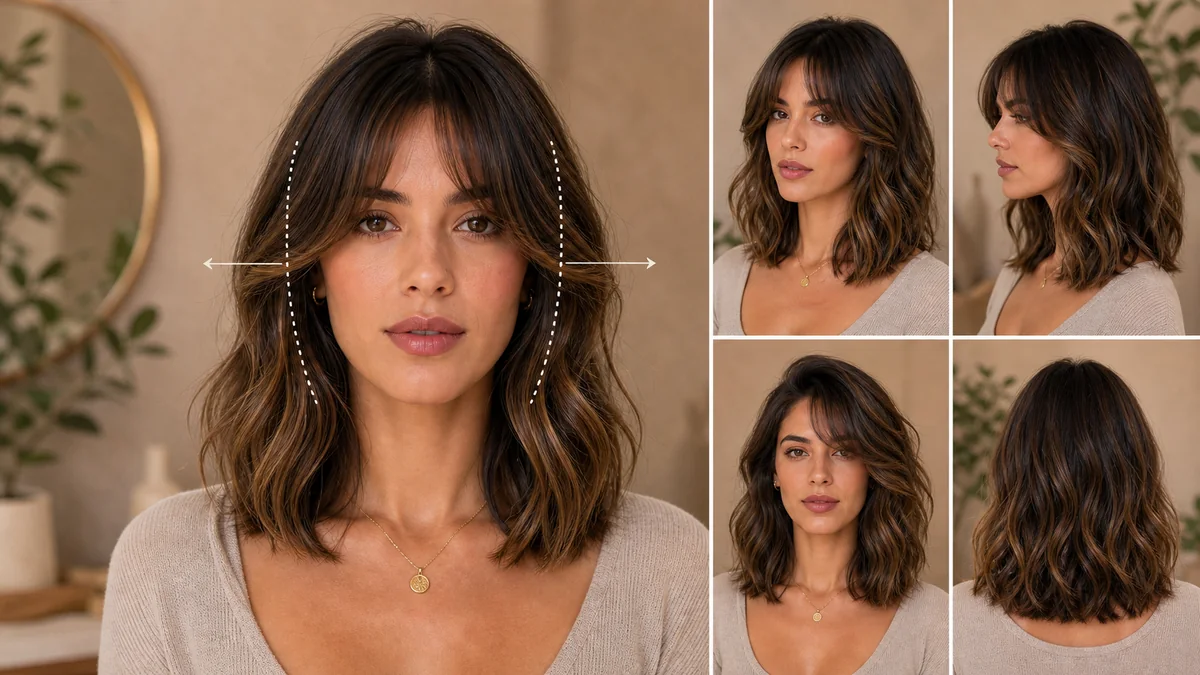
Quick Answer
Oblong faces are noticeably longer than they are wide, with a long vertical line running from forehead to chin. The most helpful styling directions add horizontal width through bangs, layers, waves, and side volume. Shoulder-length styles with curtain bangs, waves, and collarbone layers are common starting points. The goal is to add width and balance, not to shorten the face. If you prefer longer hair, pair it with side volume and a fringe. If you prefer shorter styles, keep the sides full and avoid tight crops.
Understanding Oblong Face Proportions
An oblong face has a length that is noticeably greater than its width. The forehead, cheekbones, and jaw tend to be similar in width, creating a relatively straight vertical silhouette. Unlike oval faces, where length and width are closer to balance, oblong faces carry a longer vertical line from hairline to chin. This gives the face a lean, elongated appearance that can look narrow if the hair falls straight and flat alongside it.
The Styling Goal
The primary goal for oblong faces is to add horizontal visual interest and width. You want to break up the long vertical line with horizontal elements that draw the eye sideways rather than up and down. Bangs create a horizontal line across the forehead. Waves and curls introduce horizontal movement at the sides. Side volume adds width at the cheek level. Together, these elements create a more proportionate look by balancing the face's natural length with added width.
How Length, Layers, and Volume Work Together
Length alone does not help an oblong face if the hair is straight and narrow. Long straight hair that falls flat on both sides simply traces the face's existing vertical line, emphasizing its length. Layers add horizontal movement by creating breaks and texture that catch light at different levels. Bangs create a horizontal line across the forehead, immediately introducing a sideways element. Side volume at the cheekbones or jaw adds width where the face needs it most. Crown volume, however, can emphasize length if overdone, because it adds height at the top and continues the vertical direction. The interaction matters: a style with bangs but no side volume is incomplete, just as a style with side volume but a high crown can work against itself.
Hairstyle Directions to Explore
- Shoulder-length with curtain bangs: The length sits at a natural breakpoint, and curtain bangs create a horizontal frame across the upper face while leaving the sides open for volume.
- Waves or curls with side volume: Waves introduce horizontal curves that add width at the cheek and jaw levels. For longer styles, this is one of the most reliable ways to add balance.
- Collarbone-length with layers: Layers starting at or below the chin create movement that breaks up vertical lines. This length is long enough to style flexibly but short enough to avoid dragging the face downward.
- Medium length with textured fringe: A textured fringe adds a soft horizontal line, while medium length keeps the overall silhouette from becoming too narrow.
Adding Horizontal Width Without Losing Length: The Geometry of Bangs, Layers, and Waves
Bangs alone are an incomplete solution if the rest of the hair is long, straight, and narrow. A fringe creates a horizontal line at the forehead, but if the hair below falls straight down in a narrow column, the face still reads as long. The horizontal element needs to be repeated at multiple levels to truly balance the silhouette.
Layers, waves, side flicks, and collarbone volume all do the same job: they introduce horizontal eye-stops that interrupt the vertical scan. A wave at the cheek level, a layer that flicks outward at the jaw, or volume at the collarbone all create sideways movement that adds perceived width.
Crown volume above the parietal ridge can emphasize length because it extends the face upward. If you add height at the top without adding width at the sides, you reinforce the vertical direction you are trying to soften.
For naturally curly oblong faces, shrinkage-induced narrowness is often the bigger threat. As curls dry and contract, the hair can pull closer to the head, reducing side width. In this case, preserving length to counteract shrinkage and using products that encourage curl expansion become important parts of the strategy.
A center part with long straight hair is the most challenging combination for an oblong face. The center part creates two vertical panels that frame the face symmetrically, and the straight hair follows the face's natural vertical line without interruption. If you prefer a center part, adding bangs and waves becomes essential to introduce the horizontal balance that the part and straight texture remove.
For Women: What to Prioritize
- Curtain bangs or fringe that create a horizontal line across the forehead
- Shoulder-length or collarbone length with layers that add movement at the sides
- Waves or soft curls that add side width at the cheek and jaw levels
- Avoid very long straight hair with a center part, which emphasizes vertical length
- Avoid high crown volume that adds height without corresponding side width
- Side part preferred over center part, as it creates asymmetry and breaks the vertical line
For Men: What to Prioritize
- Avoid very short sides with a long top, as this elongates the face by creating vertical contrast
- Textured fringe with moderate width on top, which adds a horizontal element at the forehead
- Medium-length top with soft texture rather than height
- Low to mid taper, not a high fade, to preserve some width at the sides
- Side part with moderate volume, keeping the overall silhouette balanced
- Low-volume side part as a safe default if you are unsure
- Maintenance every 3-4 weeks to prevent the style from growing into an unbalanced shape
How to Talk to Your Hairstylist or Barber
For women: Say, "I want curtain bangs and shoulder-length hair with layers that add movement at the sides. I don't want everything pulled back or falling straight down." This tells your stylist you need horizontal width, not just length management. Mention if you prefer air-drying, as this affects how layers are cut to create natural movement.
For men: Say, "I want a textured fringe with moderate width on top, and the sides kept at a low taper — not shaved high. I want the top to have width, not just height." This prevents the common mistake of creating a tall, narrow silhouette that emphasizes face length. If you prefer a side part, ask for moderate volume rather than a flat, slicked look.
Common Mistakes
- Cutting bangs without adding side width: A fringe helps, but if the rest of the hair hangs straight and narrow, the face still reads as long.
- Choosing very long straight hair with a center part: This combination follows and extends the face's vertical line.
- Adding crown volume without side balance: Height at the top emphasizes length unless the sides are equally full.
- Ignoring hair texture: Straight hair needs waves or layers to add width; curly hair needs length to counteract shrinkage.
- Asking to "make my face shorter" instead of "add width at the sides": The goal is horizontal balance, not vertical reduction.
Frequently Asked Questions
Do I need bangs?
Bangs are one of the most effective tools for oblong faces because they create a horizontal line across the forehead. If you prefer not to wear bangs, you can still add balance with waves, side volume, and a side part, but the effect is generally less pronounced.
Can oblong faces wear long hair?
Yes, but long hair works best when it has waves, layers, or side volume. Very long straight hair that falls flat can emphasize length. If you prefer long hair, focus on adding texture and width at the sides.
What about very short hair?
Very short hair can work if the sides are kept full and the top has width rather than height. Avoid styles with very short sides and a tall top, as this elongates the face. A textured crop with moderate length on top is a safer choice.
How do I add width with straight hair?
Use layers that flick outward at the cheek or jaw, blow-dry the sides outward with a round brush, and consider a side part that allows the hair to sweep across the forehead. A blunt cut that falls straight down will not add width.
What if my hair is naturally curly?
Curly hair naturally adds width, which is an advantage for oblong faces. The main challenge is shrinkage, which can reduce the perceived width as curls dry. Preserve enough length so that shrinkage does not pull the hair too close to the head, and use products that encourage curl definition and expansion.
Related FaceFit Guides
- Face Shapes Overview
- Oblong Face Shape Guide
- Oblong Face Hairstyles Guide
- Oblong Face Glasses Guide
- Best glasses for oblong faces — pair your haircut with proportion-matching frames.
- Why face shape matters when choosing hairstyles — the underlying logic behind cut–face fit.
- What is my face shape? — start here if you are still between two shapes.
Find Your Face Shape
Not sure if you have an oblong face? Upload a photo to our face shape detector and get a personalized analysis with hairstyle recommendations tailored to your proportions.
Want to see hairstyles on your face?
Start with your face-shape result, then explore hairstyle directions for length, layers, bangs, and volume.
Find your face shape