Best Hairstyles for Heart-Shaped Faces: Balance a Narrow Chin
Want to see hairstyles on your face?
Start with your face-shape result, then explore hairstyle directions for length, layers, bangs, and volume.
Find your face shape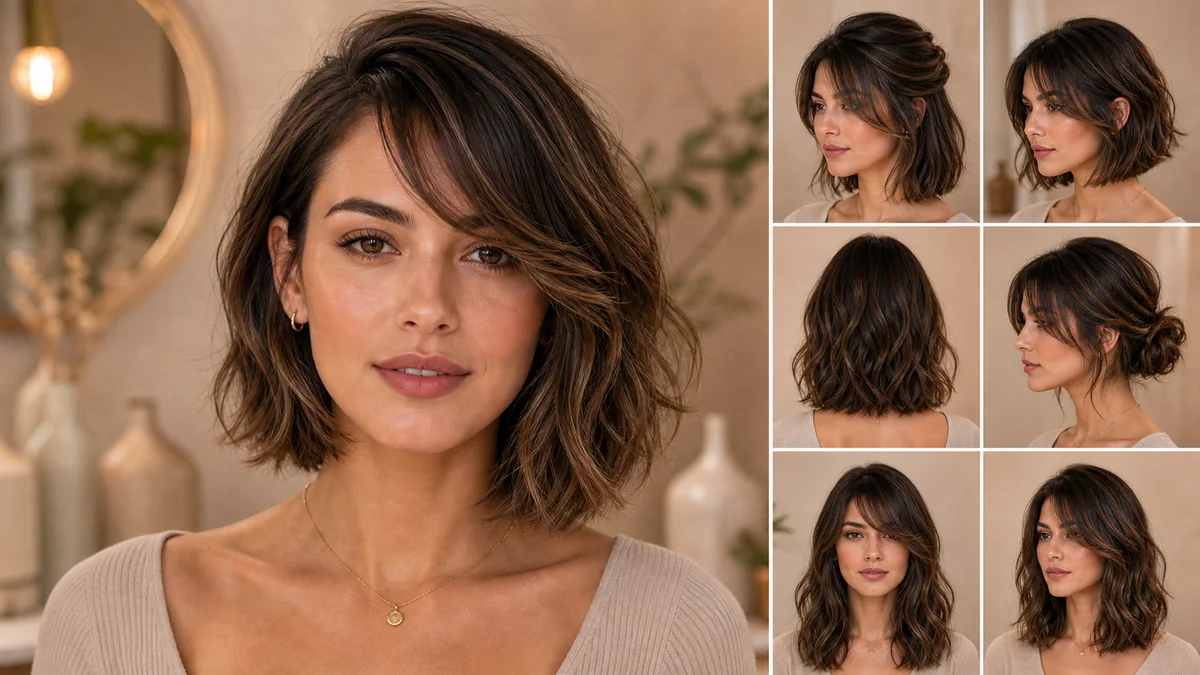
Quick Answer
Heart-shaped faces have a wider forehead and a narrower chin. The most helpful hairstyle directions add softness and visual weight near the jaw while avoiding heavy crown volume. Chin-length bobs, collarbone lobs, and styles with soft ends around the jaw are common starting points. The goal is to balance the lower face with the upper face, not to hide the forehead.
If you prefer longer styles, layers that start at jaw level and move outward help draw the eye downward. For shorter styles, a chin-length bob with soft, non-stacked ends adds presence without bulk. Men with heart-shaped faces often benefit from a textured fringe with moderate forehead coverage and a soft, medium-length top. The principle is consistent: soften the transition from cheek to chin, and avoid amplifying the forehead.
Understanding Heart-Shaped Face Proportions
A heart-shaped face is defined by width at the forehead that exceeds the width at the cheekbones and jaw. The cheekbones are usually narrower than the forehead, and the jaw narrows to a defined chin. Face length is typically moderate, giving enough vertical room to place layers and length strategically.
Some heart-shaped faces also have a widow's peak or an M-shaped hairline. This does not change the core proportion, but it can affect how fringe sits on the forehead. The key relationship to remember is forehead width relative to chin width: the greater the difference, the more balance the lower face needs.
The Styling Goal
The primary goal is to add softness and movement near the jaw so the lower face does not feel disconnected from the upper face. This means creating presence at the chin without turning the lower face into a heavy block.
Avoid amplifying forehead width with heavy top volume or wide, horizontal styles. Crown height and wide-set upper volume draw attention to the already-widest part of the face. The balance should come from the jaw, not from competing volume at the top.
How Length, Layers, and Volume Work Together
Length that ends near the jaw adds presence where it is needed most. A bob or lob that lands at the chin or collarbone naturally frames the lower face and gives the eye a reason to travel downward.
Layers that direct movement outward at the chin create width. Inward-curling layers or heavy stacking at the nape can make the lower face feel dense rather than balanced. Outward movement feels lighter and more proportional.
Volume at the crown emphasizes the forehead. Volume at the jaw balances it. If you add height at the top, you need even more presence at the bottom to compensate. In most cases, it is easier to keep crown volume low and let the jaw do the balancing work.
Hairstyle Directions to Explore
- Chin-length bob with soft ends: Ends that are not stacked or heavily layered keep the jaw line soft. A slight outward flick or natural wave at the chin adds width without bulk.
- Collarbone lob with outward movement: The extra length past the chin gives more room for waves or layers that move outward. This creates a gentle flare that balances the upper face.
- Long hair with layers at jaw level: Layers that begin at the jaw and continue downward draw attention to the lower face. Avoid layers that start at the cheekbone, which shift focus upward.
- Side-swept bangs or light fringe: A diagonal line across the forehead breaks up the width better than a heavy horizontal line. Light coverage is usually enough; heavy coverage can overcorrect.
Balancing a Narrow Chin Without Bottom-Heavy Bulk: Volume Direction Matters More Than Volume Amount
The common advice to "add bottom volume" is incomplete. The direction of movement matters more than the amount of hair.
A flick-out at the chin sends hair outward, creating a gentle horizontal line that widens the jaw silhouette. A tuck-under sends hair inward, which can make the chin look smaller. Natural fall without styling leaves the jaw undefined. If you want balance, the ends need to move outward or at least sit with some horizontal presence.
A heavy stacked bob creates bulk rather than balance. Stacking builds weight at the back of the head and the nape. That weight sits low and can make the head look bottom-heavy without actually widening the jaw line in a flattering way. Light, outward-moving waves work better because they create width at the sides of the chin, which is where the balance is needed.
A widow's peak or M-shaped hairline affects bangs choice. Heavy blunt bangs that sit straight across can emphasize the width of the forehead by creating a strong horizontal line at the top. Side-swept bangs, curtain bangs, or lighter fringe break up that line and work better with a peaked hairline. If you have been wearing heavy bangs and want to transition, ask your stylist to thin and lengthen them over 8 to 12 weeks rather than removing them all at once.
For Women: What to Prioritize
- Chin-length bob with soft, non-stacked ends
- Collarbone lob with waves that move outward at the jaw
- Long hair with layers starting at jaw level, not at the cheekbone
- Side-swept bangs or curtain bangs rather than heavy blunt bangs
- Avoid high crown volume or teasing at the roots
- For ponytails and updos, soften the top and add gentle volume at the nape rather than pulling everything tight and high
For Men: What to Prioritize
- Avoid very short cuts that expose the full forehead
- Textured fringe with moderate length and soft edges
- Medium top with soft texture rather than stiff, upright height
- Tapered sides that are not too tight at the temples
- Side-swept texture rather than a forward fringe that sits heavy on the forehead
- A low-volume side part is a safe option if you are unsure
- Maintenance every 3 to 4 weeks keeps the fringe from growing too heavy
How to Talk to Your Hairstylist or Barber
For women, try this: "I want a bob that ends at my chin with soft, non-stacked ends. I want the hair to move outward at my jaw, not curl under. I want light bangs, not heavy ones."
For men, try this: "I want a textured fringe that covers part of my forehead without being heavy. I want the top soft and medium length, not spiked up."
These instructions focus on structure rather than style names. A stylist can interpret "soft, non-stacked ends" or "textured fringe" across many specific cuts. If you bring a reference photo, use these phrases to explain what you want the hair to do, not just what you want it to look like.
Common Mistakes
- Adding heavy crown volume: Height at the top emphasizes the forehead and makes the top-heavy proportion more obvious.
- Choosing a stacked bob: Stacking creates weight at the nape that can look bulky without actually balancing the upper face.
- Using heavy blunt bangs: A thick, straight fringe adds a horizontal line across the widest part of the face and can make the chin look even narrower by contrast.
- Ignoring hairline shape: A widow's peak or M-shaped hairline changes how bangs fall. What works for a straight hairline may not sit correctly on a peaked one.
- Confusing heart-shaped with diamond face: A diamond face has cheekbones wider than the forehead. A heart-shaped face has a forehead wider than the cheekbones. The widest point determines which direction you should take.
Frequently Asked Questions
Can heart-shaped faces wear very short hair?
Very short cuts that expose the full forehead and jaw can emphasize the width imbalance. If you prefer short hair, keep some fringe or texture at the forehead and enough length at the sides to soften the jaw transition.
Are bangs necessary?
Not strictly. Light fringe or a side part that breaks up the forehead can be enough. The goal is to reduce the visual width of the upper face, and bangs are one way to do that. If you prefer no bangs, a deep side part with face-framing layers can work.
What if I have a widow's peak?
A widow's peak pairs better with side-swept or curtain bangs than with a straight blunt fringe. The peak creates a natural center point, and a diagonal or parted fringe follows that geometry more naturally.
How do I tell heart-shaped from diamond?
Check where your face is widest. If the forehead is wider than the cheekbones, you have a heart-shaped face. If the cheekbones are wider than the forehead, you have a diamond face. See our diamond face comparison for more detail.
What about center parts?
A center part without bangs tends to divide the forehead symmetrically and can make the width feel more prominent. If you prefer a center part, pair it with light curtain bangs or face-framing pieces that break up the upper face.
Related FaceFit Guides
- Face Shapes Overview
- Heart Face Hairstyles
- Glasses for Heart Faces
- Diamond Face Comparison
- Best glasses for heart-shaped faces — pair your haircut with proportion-matching frames.
- Why face shape matters when choosing hairstyles — the underlying logic behind cut–face fit.
- What is my face shape? — start here if you are still between heart and diamond.
Ready to confirm your face shape and get personalized recommendations? Try our Face Shape Detector and see which styles match your proportions.
Want to see hairstyles on your face?
Start with your face-shape result, then explore hairstyle directions for length, layers, bangs, and volume.
Find your face shape